
Library
Why Choose Embroidered Logos for Workwear?
Aug
A logo that cracks after a handful of washes sends the wrong message before an employee has even spoken to a customer. That is why choose embroidered logos is a practical question for any business buying staff uniforms, not simply a matter of style. For garments worn repeatedly in customer-facing, industrial or outdoor roles, embroidery gives branding a durable, established and professional finish.
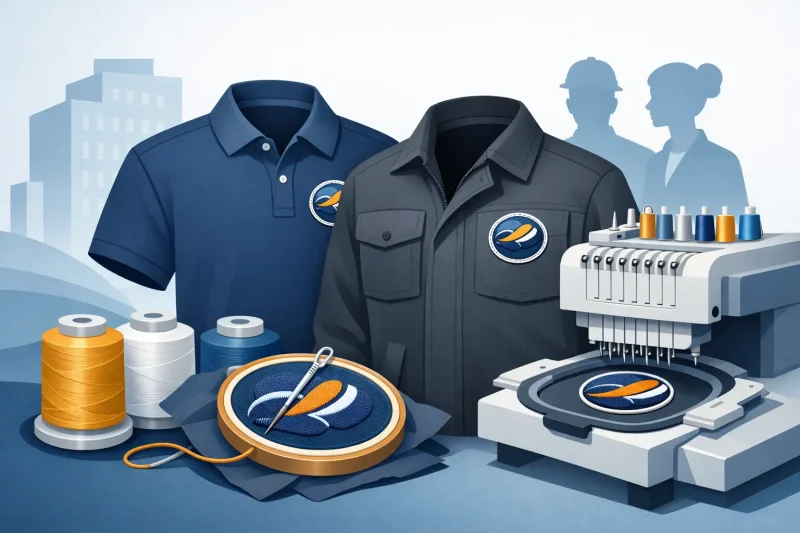
A well-produced embroidered logo becomes part of the garment rather than a surface layer applied to it. From smart office shirts and hospitality aprons to fleeces, polo shirts and work jackets, it helps teams look consistent through the working week and over the life of the clothing.
Why choose embroidered logos for staff uniforms?
Embroidery uses coloured threads stitched directly into the fabric to reproduce your logo, lettering or selected design elements. The result has texture, depth and a quality that customers often associate with established businesses. It is particularly effective where staff regularly meet clients, visit sites, welcome guests or work alongside other contractors.
For a facilities manager or procurement team, the benefit is not only visual. A consistent embroidered logo makes it easier to maintain a recognisable standard across different departments, locations and garment types. A receptionist in a blouse, an engineer in a sweatshirt and a warehouse colleague in a fleece can all represent the same business clearly, even when their clothing needs are different.
This matters because uniform is part of day-to-day brand delivery. Customers may not comment on it, but they notice whether people look identifiable, prepared and professional. Clear branding can also help visitors find the right person to ask for support, which is valuable in hospitality, healthcare, retail, education and busy commercial sites.
Built for repeat wear and regular washing
Durability is one of the strongest reasons businesses choose embroidery. When the correct thread, backing and stitching method are matched to the garment, an embroidered design stands up well to regular wear and laundering. It is not dependent on a large printed surface remaining intact, so it is often a reliable choice for uniform ranges expected to stay in service for months or longer.
That does not mean every embroidered logo will last indefinitely regardless of treatment. Excessive heat, harsh laundering and unsuitable garment care can affect both clothing and branding. The starting point is selecting a garment appropriate for the role, then applying the logo in a way that suits its fabric and intended use.
Embroidery works especially well on garments with enough structure to support the stitching, including polos, shirts, sweatshirts, fleeces, softshells, jackets, caps and heavier knitwear. For businesses issuing clothing at scale, that durability can reduce the frequency of replacing items purely because the branding has deteriorated.
The financial value is therefore broader than the unit cost. A lower-cost logo application may be right for a short campaign or event, but it can be a false economy if garments need replacing earlier than planned. For core workwear, a polished finish that continues to represent the business well can offer better value over the garment’s working life.
A professional finish customers can recognise
Embroidery has a tactile, premium appearance that suits organisations aiming for a dependable and established image. The raised thread gives logos definition, particularly on darker garments where contrast is important. It can make even practical clothing, such as fleeces and outerwear, feel like a considered part of the company uniform rather than an off-the-shelf item.
For teams working in front of clients, presentation influences trust. A clean, consistent logo helps reinforce that staff are part of one organised business, whether they are attending a property, delivering a service, managing a venue or welcoming a customer. It also gives employees clothing they are more likely to feel comfortable wearing with pride.
Placement is important. A left-chest logo remains the standard choice for many uniform programmes because it is visible without overwhelming the garment. Sleeve embroidery can add detail for teamwear or selected roles, while a larger back design may suit outerwear where identification at distance matters. The right choice depends on the garment, logo shape and the environment in which the team works.
Embroidery is not always the right answer
A practical uniform programme uses the most suitable branding method, not one method for every item. Embroidery can have limitations with very small text, intricate gradients or logos containing fine detail. Stitching has physical constraints, and forcing a complex design into a small embroidered area can make it harder to read.
Vinyl logo application may be the better option for high-visibility clothing, large back graphics, bold campaign designs, short runs or designs with details that cannot be reproduced clearly in thread. It can also be more suitable where a lightweight garment would be affected by the density of an embroidered design.
The fabric matters too. Very thin, stretchy or delicate materials may require a different approach to avoid puckering or distortion. A specialist supplier should assess the logo alongside the chosen garment before production, rather than treating personalisation as an afterthought.
For many businesses, the answer is a mixed approach. Embroidered chest logos can create a smart, durable core identity, while vinyl is used for large-format branding, role titles or hi-vis requirements. This keeps the uniform range practical without compromising the consistency of the brand.
Logo preparation makes the difference
The quality of embroidery begins before a needle reaches the garment. Your artwork needs to be converted into an embroidery-ready file, often called a stitch file. This process maps the thread colours, stitch direction, density and sequence required to produce a clear result.
Good logo conversion is particularly important when the original design includes small lettering, thin lines or several colours. An experienced embroidery team can advise when elements should be simplified, enlarged or adjusted so that the finished logo remains legible at the intended size. This is not changing a brand carelessly. It is adapting it responsibly for a physical medium.
Approval before a full run is equally useful. It gives the decision-maker confidence that the logo placement, scale and colour choice work on the actual garment. This can prevent costly inconsistencies when ordering for a large team or rolling out uniforms across several sites.
Easier standardisation across teams and locations
Uniform procurement becomes difficult when different managers order different garments from different suppliers, each with slightly different versions of the logo. Colours drift, placements vary and staff can look disconnected despite wearing company-branded clothing.
A managed embroidery setup helps avoid that. Once an approved logo is held on file, it can be applied consistently across suitable products and repeat orders. This is valuable for organisations with new starters, seasonal recruitment, multiple branches or changing stock levels. The approved branding does not need to be recreated every time someone needs a replacement polo shirt or an additional fleece.
At Select Branding Solutions, this approach can sit alongside a wider workwear supply programme, covering everything from businesswear and hospitality clothing to industrial garments, outerwear and accessories. Keeping garment supply, logo conversion and decoration under one roof reduces the administrative effort involved in maintaining a joined-up uniform standard.
For larger organisations, controlled ordering also supports budget management. Departments can order from an agreed range, staff receive appropriate clothing for their role and brand decision-makers retain confidence that the logo will be reproduced consistently.
Choosing the right garment and logo combination
The strongest results come from considering the uniform as a whole. A dense embroidered logo on a lightweight polo may not perform as well as the same logo on a heavier sweatshirt. Similarly, thread colours that look accurate against a white shirt may need adjusting for a navy fleece or black softshell.
Ask practical questions before placing an order. How often will the item be washed? Will staff work outdoors? Does the wearer need hi-vis compliance? Is the logo being viewed close up at a reception desk or from across a site? Will names, departments or job titles be added alongside it?
These details help determine the best garment weight, logo size and application method. They also help ensure that the uniform is comfortable enough for employees to wear consistently. Branding is most effective when the clothing itself suits the job.
A durable embroidered logo is a straightforward investment in how your people are recognised. Choose the garments around the realities of the role, prepare the artwork properly and set an approved standard that is easy to repeat. The result is workwear that keeps representing your business well, order after order.