
Library
Logo Conversion for Embroidery Explained
Jun
A logo can look sharp on a screen and still fail badly on a polo shirt. Fine lines disappear, gradients turn muddy and small text becomes unreadable once thread replaces ink. That is why logo conversion for embroidery matters. It is the stage that turns a digital logo into a stitch-ready file that works on real garments, at real sizes, in day-to-day wear.
For businesses ordering branded uniforms, this is not a minor technical step. It affects how professional your staff look, how consistent your brand appears across departments and how smoothly repeat orders can be processed. If your embroidery starts with poor conversion, the finished result will usually show it.
What logo conversion for embroidery actually means
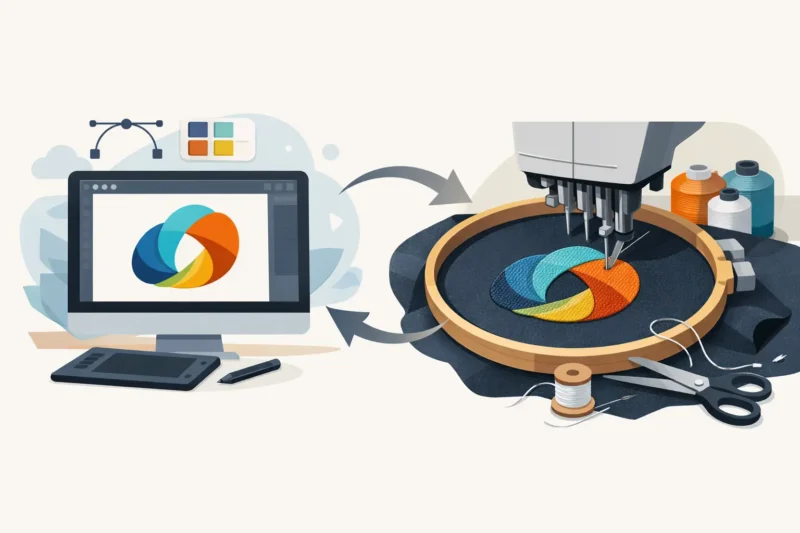
Logo conversion for embroidery is the process of taking your existing artwork and preparing it for embroidery machines. A standard logo file such as a JPG, PNG, PDF or even a vector file cannot simply be loaded into an embroidery machine and stitched perfectly. The design needs to be rebuilt as a stitch file, with instructions for stitch type, stitch direction, density, sequencing and thread changes.
This matters because embroidery is a physical application, not a printed one. Thread behaves differently to ink. Fabric moves. Different garments react in different ways. A fleece, a softshell jacket and a business shirt each need the logo to be handled with the end use in mind.
A good conversion balances brand accuracy with stitch performance. That means keeping the logo recognisable while making practical adjustments so it embroiders cleanly and lasts well in use.
Why businesses get caught out by poor embroidery conversion
The issue is usually not the logo itself. It is the assumption that any artwork can be embroidered exactly as it appears on screen. In practice, some features need adapting.
Small text is one of the most common problems. If a logo contains a strapline or detailed lettering, it may look clear in a brochure but become illegible when embroidered on the left chest of a work shirt. Thin outlines can break up. Tight curves may distort. Colour blends and shadows often need simplifying because thread cannot recreate them in the same way print can.
For a business ordering uniforms across multiple roles, these details matter. If one batch of garments has a clean, readable logo and another looks cramped or untidy, the overall brand impression suffers. Customers notice consistency, even when they do not comment on it directly.
How logo conversion for embroidery affects the finished garment
Embroidery quality is not only about the machine. The conversion stage has a direct impact on the final appearance, durability and efficiency of production.
When a logo is digitised properly, stitches sit cleanly, shapes hold their form and the design remains stable after washing and regular wear. The file is also easier to run repeatedly, which helps when you are ordering at volume or replenishing uniforms over time.
Poor conversion tends to create avoidable issues. You may see puckering around the logo, uneven coverage, misaligned elements or excess thread build-up. On lightweight fabrics, this can be especially noticeable. On heavier garments, the same problem may show up as a bulky or overly dense finish.
There is also a cost angle. If a file runs badly, production can slow down, test samples may need reworking and repeat orders become less straightforward. For procurement teams and operations managers, that means more admin and less predictability.
What a good embroidery file takes into account
A strong conversion process starts with the logo, but it should never stop there. The intended garment, logo position and finished size all influence how the file should be built.
Garment type and fabric behaviour
A logo for a cotton polo may need different settings from the same logo on a padded jacket or stretch beauty tunic. Fabrics behave differently under embroidery. Some are stable, some shift, and some need underlay and density adjustments to prevent distortion.
Logo size and placement
A chest logo, sleeve logo and large back logo each present different limitations. Fine detail that works on a large back panel may need removing or simplifying for a smaller chest position. This is normal and often necessary to preserve a clean look.
Thread colours and stitch path
Thread shades should reflect the brand as closely as possible, but the way those colours are stitched also matters. A well-planned stitch path reduces unnecessary trims and jumps, improves efficiency and gives the logo a neater finish.
Readability and durability
The best embroidery files are not simply accurate on day one. They are built to run consistently and hold their appearance over time. For uniforms used every week, that reliability is more important than trying to force every tiny design feature into the stitch-out.
When a logo needs adapting rather than copying exactly
This is often the point that needs clear explanation. Businesses understandably want their logo reproduced faithfully. In embroidery, though, exact visual copying is not always the same as achieving the best branded result.
For example, a detailed crest may need thicker borders, larger text spacing or the removal of very fine internal elements. A gradient may need to be represented as solid blocks or omitted entirely. A narrow font may need adjusting if it will be used on smaller garments.
These are not compromises for the sake of convenience. They are practical decisions that protect legibility and presentation. In most cases, a simplified embroidered version of a logo looks stronger on uniform than a technically exact but cluttered one.
The files and artwork usually needed to start
The cleaner the original artwork, the better the starting point. Vector files are usually the most useful because they show shapes and proportions clearly. High-resolution PDFs and image files can also work, although they may require more interpretation if edges are unclear.
If your business already uses branded workwear, there may also be an existing embroidery file available. That can help, but it should still be checked before production. Not all files are built to the same standard, and a file created years ago for one garment type may not be ideal for your current uniform range.
This is especially relevant for organisations standardising clothing across multiple teams. A logo that looked acceptable on one garment line may need refining when applied across businesswear, outerwear and hi-vis clothing.
Why consistency matters on repeat uniform orders
For many businesses, the real value of logo conversion for embroidery shows up over time. Once a logo has been prepared properly, it becomes far easier to maintain consistency across future orders.
That means the same logo placement, the same stitch quality and the same brand presentation whether you are ordering ten garments for a new starter group or several hundred across sites. It also reduces the risk of one-off artwork changes creeping into the process and weakening the look of the uniform estate.
For companies managing branded clothing across departments, sites or seasonal recruitment, this level of control saves time. It also supports a more professional image, which matters in customer-facing roles and team environments where presentation reflects directly on the business.
Choosing a supplier that understands the practical side
Not every embroidery service approaches logo conversion with the same level of care. Some simply run an automated process and hope the logo will stitch out well enough. That may be adequate for a one-off promotional item, but it is rarely the right approach for branded uniforms that need to represent a business properly.
An experienced supplier should look at the artwork in context. They should consider garment type, branding position, order volume and future repeatability. They should also be honest about limitations. If a logo element will not embroider clearly at the intended size, that should be explained before production, not discovered after garments are decorated.
For businesses buying uniform at scale, that practical advice is part of the service. It reduces avoidable errors and gives decision-makers more confidence in the finished result.
Select Branding Solutions works with organisations that need exactly that kind of consistency – not just garments with logos on them, but branded uniform that performs well operationally and looks right across repeat orders.
What to ask before approving embroidery conversion
Before you sign off a logo for embroidery, it is worth checking a few practical points. Ask whether the design has been adjusted for the garment and size you have chosen. Ask if small text or fine detail has been reviewed for readability. And ask whether the same file will be suitable across all the garments you plan to order.
Those questions are simple, but they help avoid the common problem of approving a logo based only on the artwork, rather than on how it will actually stitch.
A well-converted logo does more than decorate a garment. It supports brand consistency, reduces friction in repeat ordering and helps staff look properly turned out from the moment the uniform arrives. If your branded clothing needs to work hard across teams, sites and roles, that is not a detail to leave to chance.
The best embroidered logos are rarely the ones that try to copy every pixel. They are the ones built to look right, wear well and keep doing their job every time you reorder.