
Library
Best Hospitality Uniform Styles for Every Venue
Aug
A guest may not remember the exact colour of your reception desk, but they will remember whether your team looked prepared, approachable and consistent. That is why choosing the best hospitality uniform styles is not simply a purchasing decision. It affects first impressions, staff confidence, brand recognition and the practical ability of people to do their jobs well through a busy shift.
For hotels, restaurants, cafés, leisure venues and event businesses, the right uniform needs to work harder than a logo on a polo shirt. It should reflect the standard of service you promise, suit the role being performed and remain presentable after regular washing. The most effective approach is to build a coordinated uniform range around your operation rather than selecting one garment for every employee.
The best hospitality uniform styles start with the guest experience
Uniforms set the visual tone before a member of staff says a word. A five-star hotel may need tailored businesswear that conveys discretion and authority, while an independent coffee shop may be better served by relaxed aprons and quality branded tees. Neither option is automatically better. The right choice depends on your brand, customer expectations and the pace of the working environment.
Consistency matters more than formality alone. When front-of-house, bar and management teams wear garments that share a colour palette, logo placement or fabric finish, customers can identify who to approach. Staff also look like one team, even where roles require different clothing.
For multi-site organisations, this consistency becomes a practical brand-control issue. A defined uniform policy prevents local variations in shade, style and branding, helping every venue present the same professional standard.
Front-of-house styles that create confidence
Reception, concierge and host teams are often the first people a guest sees. Their clothing should look polished at close range while allowing enough movement for standing, walking and handling everyday tasks.
Tailored businesswear for hotels and premium venues
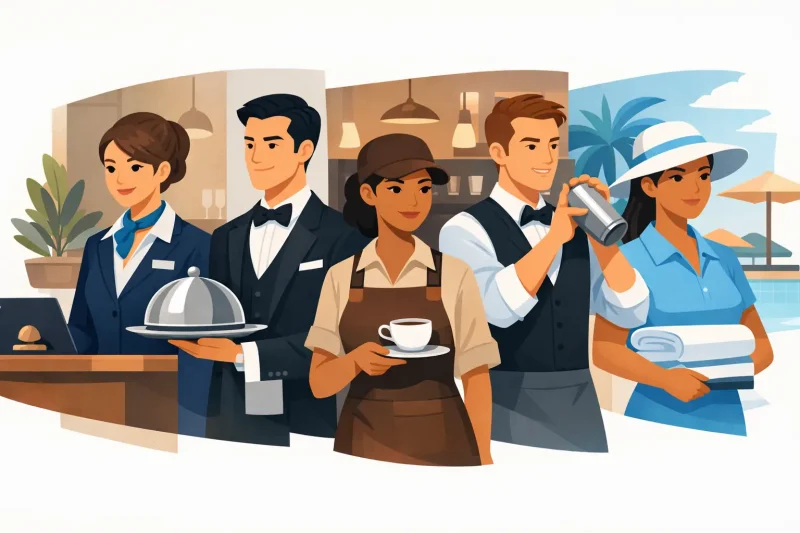
Blazers, waistcoats, tailored trousers, skirts, dresses and smart shirts remain a strong choice for hotels, private members’ clubs and formal event spaces. Navy, charcoal and black are dependable base colours because they look professional, coordinate easily and cope well with frequent wear. A branded tie, scarf, lapel pin or embroidered logo can add identity without making the outfit feel overly promotional.
Tailored styles do require careful sizing. A garment that looks excellent on a hanger but restricts movement will quickly be left unworn or replaced. Offering inclusive fits and practical size sampling before a larger rollout can reduce returns and give staff confidence in the final choice.
Smart-casual layers for modern service brands
Many contemporary hospitality businesses prefer a more relaxed look. Chinos or smart trousers paired with Oxford shirts, knitwear, branded overshirts or premium polos can feel welcoming without losing professionalism. This works particularly well for casual dining, visitor attractions, co-working spaces and boutique accommodation.
Layering is useful in venues where temperatures vary between reception areas, terraces and stock rooms. Rather than issuing separate seasonal uniforms, a coordinated overshirt, cardigan or softshell gives staff an adaptable option while retaining a clear brand image.
Restaurant and bar uniform styles should support service
Restaurant teams need clothing that presents well from the first sitting to the last, while bar staff may need greater flexibility and protection from splashes. The finest-looking uniform is not the best choice if it becomes uncomfortable during a demanding service.
Aprons remain one of the most versatile hospitality garments. Bib aprons create a traditional, practical look for bistros, bakeries and bar teams, while waist aprons suit waiting staff who need easy access to order pads, pens and card terminals. Denim, canvas and heavyweight cotton blends can add texture and durability, but lighter fabrics may be preferable in warm dining rooms.
Shirts and blouses give table service a more formal finish, particularly when paired with matching aprons. For a contemporary venue, branded polos or fitted T-shirts can work well, provided the fabric is substantial enough to hold its shape and the branding is applied neatly. A faded print or poorly positioned logo can undermine an otherwise considered uniform programme.
Colour also has an operational role. Darker garments are forgiving in bars and busy dining areas, while lighter shirts can suit daytime cafés and fine dining. Consider where staff will work, what they will carry and how regularly the garments can realistically be laundered before setting the colour scheme.
Kitchen uniforms need function before fashion
Chefwear carries a clear professional signal, but its main job is to keep kitchen teams comfortable and appropriately protected. Double-breasted chef jackets remain popular in traditional kitchens, yet lightweight chef jackets, chef T-shirts and breathable polos are often more suitable for high-temperature environments.
Look for fabrics designed for regular industrial or domestic washing, depending on your laundering arrangement. Breathability, ease of movement and a practical fit around the shoulders and arms are more valuable than decorative detail. Chef trousers should provide comfort during long shifts, with elasticated or drawstring waist options often preferred by working kitchen teams.
Aprons should be selected according to task. A durable bib apron may suit food preparation and open kitchens, while shorter styles can be more practical for staff moving between prep areas and service. Where heat, spills or food safety requirements are significant, your uniform specification should sit alongside your wider health and safety procedures rather than being treated as a purely visual decision.
Do not overlook housekeeping, maintenance and events staff
The best hospitality uniform styles account for every customer-facing and operational role. Housekeeping teams need garments that are easy to move in, durable and comfortable across active shifts. Tunics, polo shirts, practical trousers and lightweight fleeces can provide a smart, coordinated look without restricting work.
Maintenance and facilities staff may need a more workwear-led solution, including cargo trousers, durable polos, outerwear and, where required, hi-vis garments. These teams should still feel part of the same organisation. Matching logo treatment, core colours and quality standards can connect practical workwear to the wider hospitality brand.
For events teams, flexibility is key. A black shirt and branded apron may work for one function, while a formal shirt, waistcoat and tie may be required for another. Creating a small, approved range gives managers the ability to match uniform presentation to the event without sourcing ad hoc clothing each time.
Branding should look intentional, not added as an afterthought
Embroidery is a popular choice for hospitality uniforms because it provides a durable, premium finish on polos, shirts, aprons, outerwear and knitwear. It is especially effective for smaller chest logos and individual names. Vinyl logo application can be useful where a larger, bolder design is needed, particularly on certain workwear and promotional garments.
The placement and scale of branding matter. A discreet embroidered logo may be right for a premium hotel, whereas a colourful chest or back print can suit a lively casual venue. Keep the treatment consistent across garment types so a polo, apron and jacket still look like part of one collection.
Before placing a bulk order, approve a branded sample. This is the most reliable way to check thread colours, logo clarity, garment shade and placement. It also avoids costly surprises when garments are issued across multiple departments.
Build a uniform range that is easy to manage
A uniform programme should make life easier for operations and procurement teams, not create a fresh admin task every month. Start with a core range for each role, then identify approved optional layers for different weather conditions and individual preferences. Standardising colours, branding positions and garment types simplifies repeat orders and keeps replacement stock consistent.
It is worth planning for staff turnover, seasonal recruits and size changes from the outset. Holding a sensible stock profile or using a managed ordering process can prevent new starters appearing in mismatched clothing while waiting for garments to arrive. For organisations with several locations, centralised ordering and clear role-based selections reduce the risk of departments choosing unsuitable alternatives.
Select Branding Solutions helps businesses bring garment supply, embroidery and repeat uniform ordering together, giving hospitality teams a more controlled way to maintain consistent staff presentation as requirements change.
Choose for wearability, then protect the presentation
Cost per garment matters, but it should not be the only measure. A cheaper shirt that loses shape after a few washes can cost more over time than a better-quality alternative with a longer useful life. Equally, premium fabrics may not be necessary for every back-of-house role. The right balance comes from matching garment performance to how, where and how often it will be worn.
Ask staff for practical feedback during selection. They will quickly identify issues around pocket placement, sleeve length, heat, movement and fit that are easy to miss in a boardroom review. When people are comfortable in their uniform, they are more likely to wear it properly and represent your business with pride.
The strongest hospitality uniforms do not demand attention for their own sake. They give guests immediate reassurance, help staff perform confidently and make a busy operation look organised at every point of contact.