
Library
Business Uniform Ordering Guide for Buyers
Jun
A uniform order rarely goes wrong because of the garments alone. The problems usually start earlier – vague specifications, inconsistent sizing, too many decision-makers, or a buying process that works for the first delivery but falls apart when new starters arrive. This business uniform ordering guide is designed for organisations that need staff clothing to look professional, fit properly and stay easy to manage over time.
If you are ordering for office teams, hospitality staff, site workers, healthcare settings or multi-role departments, the challenge is not simply choosing garments. It is creating a repeatable system that supports your brand, your budget and your day-to-day operations.
What a good uniform order needs to achieve
A successful uniform programme does more than put everyone in matching clothing. It should present your business consistently, help staff feel prepared for their role and make reordering straightforward. That matters just as much for a front-of-house receptionist as it does for a warehouse team, a beauty therapist or an engineer visiting customer sites.
The strongest uniform decisions usually balance five things at once: role suitability, brand appearance, wearer comfort, durability and ease of replenishment. Focusing too heavily on one can create problems elsewhere. A cheaper garment may reduce initial spend but cost more in replacements. A smart style may support brand image but fail if it is impractical for active roles. Good buying decisions come from looking at the full picture, not just the unit price.
Start your business uniform ordering guide with roles, not products
Many businesses begin by browsing garments. In practice, it is far more effective to begin with who needs to wear them and what they need to do in them.
A customer-facing office team may need smart businesswear that reflects a polished brand image. Hospitality teams often need a blend of presentation, flexibility and easy care. Industrial and trade environments may require tougher fabrics, hi-vis options, weather protection or safety footwear. Health and beauty teams often prioritise comfort, movement and a clean, professional look.
When you define roles first, product selection becomes more accurate. You can separate mandatory items from optional ones, identify where branding should appear and avoid over-ordering garments that do not suit daily use. This also helps when different departments need different uniform standards under one brand.
Build a clear uniform specification
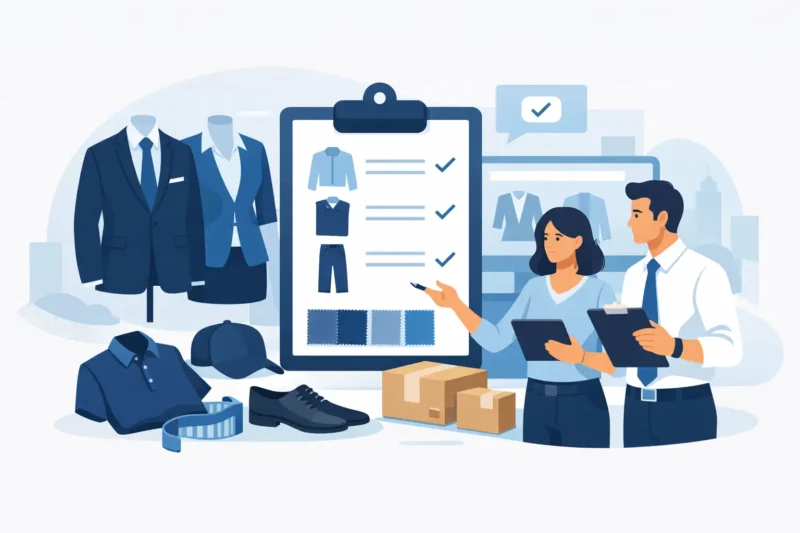
Before you request prices or place an order, write down exactly what each role requires. That should include garment type, colour, branding position, logo method, likely quantities and any special requirements such as women’s fit options, weather protection or PPE compatibility.
This stage saves time later. It prevents the common situation where one site orders navy softshell jackets, another chooses black, and a third uses a different logo version altogether. Once that happens, consistency becomes expensive to restore.
Choose garments for real working conditions
Uniform buying often looks straightforward on a screen. The real test is how the clothing performs after long shifts, repeated washing and regular wear.
Fabric weight, stretch, breathability and ease of care all matter. So does the level of stock continuity available from the supplier. A garment that looks ideal now is less useful if it disappears from the range six months later, leaving you unable to match future orders.
There is always a trade-off between presentation and practicality. Tailored garments can sharpen appearance, but they may not suit highly active roles. Heavier fabrics may last longer, but they can be less comfortable in warm environments. The right answer depends on where the uniform is worn, how often it is washed and how visible those employees are to customers.
Branding method matters more than many buyers expect
Embroidery, vinyl application and other personalisation methods each have their place. Embroidery often gives a durable, premium finish and works well for polos, shirts, knitwear, outerwear and many corporate garments. Vinyl can suit certain applications where a sharper graphic effect is needed.
The right method depends on the garment fabric, the complexity of the logo and the image you want to present. Buyers should also think about scale. If you are ordering for multiple teams and expect regular replenishment, branding consistency becomes essential. A logo that varies in size, stitch quality or placement weakens the professional impression you are trying to create.
Sizing is where many uniform orders fail
Poor sizing creates costs quickly. It leads to exchanges, unhappy staff, wasted branded stock and delays at rollout. It also affects how employees feel wearing the uniform. If people are uncomfortable, they are less likely to wear the garments well or represent the brand confidently.
That is why sizing should be treated as part of the ordering process, not an afterthought. For larger rollouts, measuring support can make a significant difference. It reduces guesswork and helps accommodate different body shapes, role needs and fit preferences.
Where formal measuring is not possible, structured size collection is still better than asking managers to estimate. Clear size charts, wearer guidance and garment samples help improve accuracy. This is particularly useful when ordering mixed product categories such as shirts, trousers, jackets and outerwear, where fit can vary significantly.
Budget for the full life of the uniform
A uniform budget should cover more than first issue. Replacement cycles, new starters, leavers, seasonal changes and department growth all affect the true cost.
The most cost-effective approach is not always the cheapest initial basket. It is often the one that reduces admin, limits replacement rates and keeps branding consistent over time. Bulk buying can help on core stock lines, particularly for stable teams, but it needs to be balanced against storage, sizing mix and staff turnover.
This is where supplier capability matters. A provider that can supply garments, apply branding and support repeat ordering through one service removes friction from the process. It also reduces the risk of departments sourcing items separately and creating inconsistency.
Think beyond the first delivery
Many buyers plan carefully for launch and less carefully for month three. That is when the practical questions begin. How do new employees order? Who approves requests? Can different sites access the correct product list? Is the branding already set up for repeat use? Can managers reorder without starting the process again?
A workable uniform system needs clear controls. Managed ordering, approved product ranges and dedicated portals can make a major difference for businesses with multiple locations or ongoing staff changes. They turn uniform buying from a one-off task into a process you can actually maintain.
Supplier selection is about service, not just stock
A large catalogue is useful, but it is only one part of the picture. For business buyers, the more important question is whether the supplier can support the operational demands behind the order.
That includes branding quality, stock reliability, guidance on garment suitability, capacity for large volumes and a clear route for repeat orders. If your business needs embroidery, logo conversion, on-site measuring or support across multiple departments, those services should be considered early rather than added later.
A dependable supplier should also be realistic. Not every garment is right for every logo. Not every low-cost option will hold up under hard wear. Practical advice matters because mistakes are expensive once items have been branded.
Common mistakes this business uniform ordering guide can help you avoid
The most frequent issues are avoidable. Businesses often approve garments without checking wear conditions, underestimate the importance of sizing, allow too many variations by department or treat repeat ordering as someone else’s problem.
Another common mistake is buying from separate sources to save time. One supplier for garments, another for embroidery and another for top-up orders usually creates more admin, not less. It also makes accountability harder when problems arise.
Consistency is easier when one supplier can manage supply, branding and replenishment together. For businesses ordering at scale, that joined-up approach tends to save time as well as protect presentation.
A practical approach for growing teams
If your organisation is expanding, opening sites or standardising brand presentation, build your uniform programme to grow with you. Keep approved ranges simple. Define branding rules clearly. Record product codes and logo positions. Make sure reordering can happen without revisiting every earlier decision.
This is where experience counts. Suppliers that handle high garment volumes and ongoing account management are often better placed to support growth than those focused only on one-off sales. Select Branding Solutions, for example, works with organisations that need uniform supply, branding and management to function as one service rather than three separate tasks.
A good uniform order should reduce workload, not create more of it. When garments are right for the role, branding is applied consistently and replenishment is built into the process, uniforms become easier to manage and more valuable to the business. The best place to start is with a clear specification and a supplier that understands what happens after the first box arrives.