
Library
Why On Site Uniform Measuring Matters
Jun
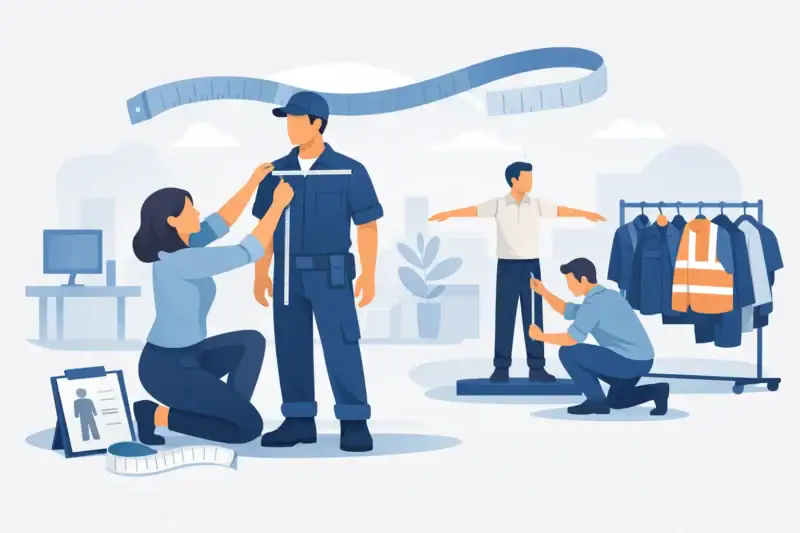
A uniform rollout usually starts with good intentions and ends with a spreadsheet full of guesswork. Sizes are collected by line managers, staff pick what they normally wear on the high street, and the first delivery reveals the problem – jackets too tight across the shoulders, trousers too long for active roles, and branded garments that cannot simply be returned once logos have been applied. That is exactly why on site uniform measuring matters for businesses that need staff to look consistent and feel comfortable from day one.
For organisations buying uniforms at scale, fit is not a minor detail. It affects presentation, staff confidence, replacement rates and the overall cost of the programme. When uniforms are being ordered for office teams, hospitality staff, warehouse operatives, healthcare settings or mixed-role workforces, a proper measuring service removes much of the uncertainty that slows down procurement and leads to expensive corrections later.
What on site uniform measuring actually solves
The obvious benefit is better fitting garments, but the commercial value runs wider than that. On site uniform measuring gives businesses a structured way to size employees against the garments they will actually wear, rather than relying on assumptions or generic size charts.
That distinction matters because uniform sizing is rarely straightforward. A fitted hospitality blouse will sit very differently to a unisex polo shirt. A corporate jacket has different fit expectations from a hi-vis softshell. Footwear, outerwear and work trousers all bring their own sizing considerations, especially when staff need room for movement, layering or PPE.
When measurements are taken on site, the process becomes more controlled. Employees can be assessed for the role they perform, the garments selected for that role and the working environment they are in. That leads to a more accurate first order, fewer exchanges and a more consistent appearance across the team.
On site uniform measuring and business efficiency
For a single small team, asking employees to submit their own sizes may feel manageable. For a business with multiple departments, shifts or sites, it often creates avoidable admin. Procurement teams end up chasing missing information, correcting unclear entries and dealing with reorders once the first issue is identified.
On site uniform measuring helps reduce that burden because the sizing stage is handled properly at the start. Instead of collecting mixed information from different managers, businesses have one process, one set of records and a clearer route into ordering. That is particularly useful where staff turnover is regular, new starters need to be issued quickly or brand consistency is a visible part of customer experience.
There is also a cost control benefit. Branded garments are not the same as plain stock items. Once embroidery or logo application has been added, the room for error narrows. If the wrong size has been chosen, the cost is not just the replacement garment. It includes wasted branding, additional handling and the operational disruption of staff waiting for the correct kit.
Why fit affects more than appearance
A well-fitted uniform looks professional, but the impact goes beyond appearance. Staff are more likely to wear garments correctly when they fit properly and feel appropriate for the job. That sounds simple, yet it has a direct effect on day-to-day presentation.
If a shirt pulls across the chest, a tunic restricts movement or trousers sit badly through a long shift, employees notice it immediately. In customer-facing settings, discomfort often shows in posture and confidence. In practical roles, poor fit can interfere with movement, layering and general ease of work.
For employers, this is where uniform becomes part of operational performance rather than a basic purchasing exercise. Good fit supports staff comfort, staff pride and consistency of presentation. Poor fit leads to complaints, ad hoc replacements and garments left unworn in lockers or cupboards.
Where on site uniform measuring makes the biggest difference
The value is often highest in businesses with varied job roles. A company may need tailored businesswear for front-of-house staff, durable workwear for operational teams and branded outerwear for site visits. Using a single self-sizing method across all those garment types can create problems quickly.
It also makes a strong difference where workforces are spread across departments or locations. The larger the rollout, the more helpful it is to have a measuring process that is consistent and professionally managed. That applies to corporate offices, hotels, care environments, schools, leisure operators, industrial teams and construction-based businesses alike.
There is also a people benefit. Employees appreciate a process that feels considered rather than rushed. A measuring service signals that the employer is taking the uniform issue seriously, not simply issuing standard sizes and hoping for the best. That can make the rollout smoother, especially where staff have had poor experiences with uniforms before.
What to expect from a professional measuring service
A proper on site uniform measuring service should not feel complicated, but it should feel organised. The aim is to make the process efficient for both the employer and the employees while producing accurate sizing information that can be used for ordering and future replenishment.
In practice, this usually means scheduling measuring sessions around your operation, working through teams in a structured way and recording garment choices and sizes clearly. For many businesses, the real value comes from joining up measuring with supply and branding rather than treating them as separate tasks.
That joined-up approach reduces the risk of data being lost between stages. It also makes repeat ordering simpler. Once sizes, approved garment ranges and branding details are held properly, future orders become faster and more controlled.
For that reason, on site measuring tends to work best as part of a wider managed uniform service. Businesses are not just buying a tape measure and a fitting session. They are creating a better foundation for ordering, issuing and replenishing uniforms over time.
The trade-off: when it makes sense and when it may not
On site uniform measuring is not necessary for every order. If you are buying a small number of standard garments for a settled team, and the product range is simple, a remote sizing process may be enough. Not every business needs the same level of support.
Where it becomes worthwhile is when the cost of getting it wrong is higher than the cost of doing it properly. That usually means larger headcounts, branded garments, multiple role types, ongoing replenishment or a strong requirement for smart and consistent presentation.
There is also the question of timing. Some businesses delay measuring because they want to move quickly, but that can be a false economy. Saving a little time at the beginning can create more disruption later if the first issue is wrong and the replacements need to be reprocessed.
A pragmatic supplier will be honest about that balance. The goal is not to add steps for the sake of it. The goal is to match the process to the size, complexity and visibility of your uniform programme.
Choosing a supplier that can support the whole process
If your business is considering on site uniform measuring, it is worth looking beyond the measuring visit itself. The stronger option is usually a supplier that can support product selection, branding application, ordering controls and replenishment after the initial rollout.
That matters because uniform problems rarely happen in isolation. A sizing issue often sits alongside inconsistent garment choice, unclear approvals or a fragmented ordering process. Working with one experienced supplier helps keep those issues connected and easier to manage.
For businesses rolling out branded uniforms across teams, the practical advantage is clear. You gain better fit data, clearer ordering and a more reliable route from garment selection through to embroidered or printed issue. That is the kind of support that helps procurement teams stay in control while giving employees clothing that looks right and performs as expected.
At Select Branding Solutions, that is where on-site support adds real value – not as a standalone extra, but as part of a dependable uniform service built for businesses that need consistency, scale and straightforward repeat ordering.
Uniform decisions are often judged only when something goes wrong. A proper measuring process helps prevent those problems before they reach your staff, your customers and your budget.