
Library
When Vinyl Logo Workwear Printing Works Best
Jun
A warehouse team needs ten softshell jackets by Friday. A salon wants every therapist’s name added to tunics. A facilities contractor is rolling out hi-vis across several sites, but each department needs a slightly different marking. This is where vinyl logo workwear printing often makes commercial sense.
For many businesses, the question is not whether garments should be branded, but which branding method suits the garment, the logo and the way the clothing will be used. Vinyl logo workwear printing is a practical option when you need clean, high-impact personalisation, especially for smaller runs, staff names, job titles and straightforward logo placement. Used in the right setting, it delivers a smart finish without overcomplicating the order.
What vinyl logo workwear printing actually is
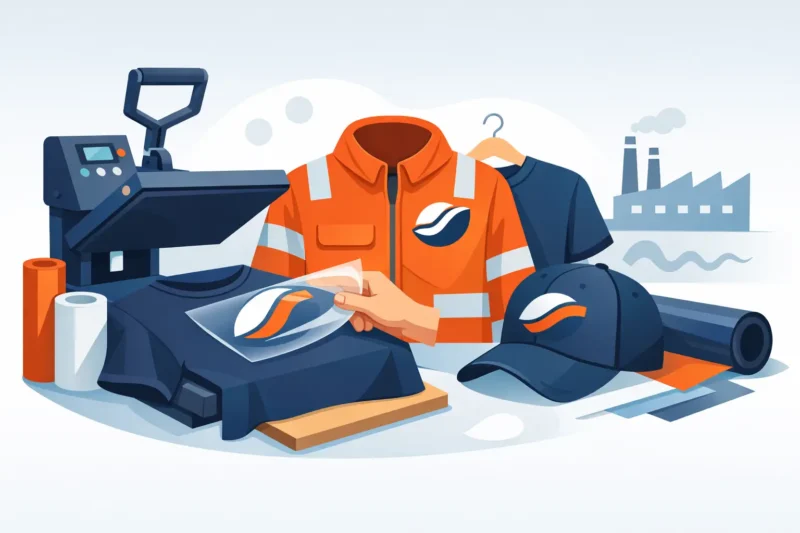
Vinyl logo workwear printing applies cut or printed vinyl to the surface of a garment using heat and pressure. Rather than stitching a design into the fabric, the logo sits on top of the garment as a bonded layer. The result is crisp, clear branding that works particularly well for bold artwork, simple shapes, lettering and numbering.
That matters because not every logo behaves the same way in production. Some designs are ideal for embroidery, where texture and thread add a premium feel. Others benefit more from the smooth, precise finish that vinyl can provide. If your branding includes solid blocks of colour, sharp text or individual names, vinyl can often produce the cleaner result.
In business terms, this gives buyers another useful option. Instead of forcing every garment and every logo through one decoration method, you can choose what is most suitable for the job, the budget and the practical demands of the role.
Where vinyl works especially well on branded workwear
The strongest use case for vinyl is usually straightforward personalisation. Staff names on hospitality uniforms, role titles on healthcare garments, player numbers on teamwear and clear branding on promotional outerwear are all common examples. Where garments need individual identification, vinyl is often the more efficient route.
It also performs well on items where embroidery may be less suitable. Lightweight jackets, performance garments and some hi-vis styles can be better suited to a printed application, depending on the logo position and fabric. The flatter finish can help preserve the garment’s look and feel, particularly where heavy stitching might distort the material.
For companies ordering across different departments, that flexibility can be valuable. One team may need branded polos with a chest logo, while another needs names and job titles added to outerwear. Vinyl allows for that level of variation without turning the order process into a burden.
The main advantages for business buyers
The first advantage is visual clarity. Vinyl gives a neat, defined finish, which is especially useful for logos with strong lines or text that needs to remain readable at smaller sizes. If the branding must look sharp from reception desks to customer-facing site visits, that precision counts.
The second is adaptability. Vinyl logo workwear printing is well suited to mixed personalisation, which helps businesses that issue clothing by role, location or individual employee. If each garment needs slight changes, such as a name on one line and a department on another, the process is usually straightforward.
The third is cost control on selected order types. For shorter runs or custom one-off additions, vinyl can be a sensible option because it avoids some of the setup considerations associated with other methods. That does not mean it is always the cheapest route, but it can be commercially efficient when flexibility matters as much as unit cost.
There is also a speed benefit in many cases. When businesses need top-up orders, replacement garments or fast-turnaround personalisation, vinyl can support a more responsive supply model. For operations teams trying to onboard staff quickly or maintain consistency across sites, that can make a real difference.
The trade-offs to understand before you choose it
No branding method is right for every garment. Vinyl logo workwear printing has clear strengths, but sensible buyers should weigh the trade-offs.
If garments are going through very heavy industrial laundering, exposure to harsh conditions or constant abrasion, suitability needs to be checked carefully. Some environments place much tougher demands on branded clothing than others. What works perfectly on a front-of-house polo may not be the best option for a heavily used trade garment.
There is also the question of design complexity. Simple logos, names and numbering tend to suit vinyl well. Very intricate artwork, tiny detail or branding that needs a textured stitched appearance may point you in a different direction. In those cases, embroidery or another print method may deliver a stronger result.
Garment choice matters too. Fabric type, stretch, coating and wash requirements all affect performance. That is why the best decisions are made by looking at the whole brief rather than choosing a branding method in isolation. The logo, garment, working environment and reorder pattern all need to line up.
Vinyl logo workwear printing vs embroidery
This is often the comparison buyers care about most. Embroidery generally gives a classic, durable and premium look, particularly on polos, fleeces, shirts and heavier garments. It is a strong option for corporate branding where texture and a traditional finish support the image you want to project.
Vinyl, by contrast, is often the better fit where you need crisp edges, variable data or garment personalisation. Names, numbers and role titles are where it comes into its own. It can also suit lighter garments or logos that do not translate neatly into thread.
The choice is not about one method being better overall. It depends on the intended use. A company issuing executive fleeces to field managers may prefer embroidery for a more established look. The same company might use vinyl for numbered hi-vis vests, visitor garments or teamwear where clear identification is the priority.
For larger uniform programmes, a mixed approach is often the most practical answer. One decoration method for core brand garments, another for specialist items and personalised top-ups. That tends to give better performance and better value than trying to standardise every product in the same way.
What to consider before placing an order
Before approving branded clothing, it helps to ask a few practical questions. How often will the garments be washed? Are they worn indoors or outdoors? Does each item need the same logo, or will names and departments vary? Is the priority a premium corporate appearance, or fast and efficient identification?
Logo quality should be reviewed early as well. A clean artwork file supports a cleaner finished result, whichever application method is used. Positioning matters too. Left chest, large back prints, sleeve details and name placement all affect visibility and wearability.
This is also where supplier experience counts. Uniform branding is not only about applying a logo. It is about choosing garments that suit the role, selecting the right decoration method, managing consistency across repeat orders and making it easy to replenish stock as teams grow. Businesses rarely struggle because they cannot buy a polo shirt. They struggle because they need dozens or hundreds of garments, across multiple wearers, with the right branding applied correctly every time.
Why managed uniform supply makes a difference
For organisations ordering workwear at scale, the real value comes from process as much as product. If branding decisions are made garment by garment, reorder by reorder, standards tend to drift. Logos change size, placements vary and different departments end up looking like separate businesses.
A managed approach keeps branding consistent and ordering simpler. That means approved logo files, agreed garment ranges, clear decoration rules and an easier route for repeat purchases. It also reduces the risk of wasting money on unsuitable products or branding methods that do not hold up to day-to-day use.
This is where an experienced supplier can add practical value beyond fulfilment. Select Branding Solutions works with businesses that need that kind of consistency across uniforms, industrial clothing and branded workwear, with decoration methods matched to real operational needs rather than guesswork.
Choosing vinyl for the right reasons
Vinyl is not a shortcut and it is not a compromise when it is used properly. It is a specific branding solution that suits specific requirements. If your business needs sharp logos, names, numbering or flexible personalisation across selected garments, vinyl can be the most effective choice.
The best results usually come from asking a simple commercial question first: what does this garment need to do in the real world? Once that is clear, the right branding method tends to follow. Get that part right, and the clothing does more than carry a logo – it supports presentation, consistency and day-to-day ease of ordering.